
Fabas 2026/27: Europe Will Break the Stalemate

The Australian faba bean market has settled into a standoff on current-crop (25/26) beans.
Buyers are bidding around $400/mt delivered port zones. Sellers are asking $440–450/mt. Very little volume is trading at either level.
Stalemates like this are not resolved from within. They are broken by new information.
The next meaningful information arrives from the Northern Hemisphere, where Europe's bean harvest is about to come off.
We have conducted a thorough review of the offshore harvests, freight, currency and our own market, and our view is straightforward. Europe's crop will decide when Egypt engages and at what level. The Australian dollar will decide how much of that value arrives back at port. And any forward market that develops between now and our 26/27 harvest must pay growers for production and quality risk. This report works through each in turn.
A word on our June guide. We suggested then that the mid-$500's/mt was achievable delivered Southern Port Zones, and nothing in this review changes that destination — if anything, the deterioration in European crop conditions supports it.
What has shifted is the path and the timing. France's surplus is moving first, Egypt can afford to wait, and war-driven freight is leaning on exporter bids in the near term. We believe the market reaches for our guide once the European quality question is answered — and the evidence there is moving in growers' favour.
Europe Is Harvesting Two Different Crops
France enters this harvest carrying a supply overhang.
Last season's record crop weighed on European values through the first half of 2026. Yields have held strong into the new season, and French beans have been moving into markets Australia normally regards as its own — including new volumes into Egypt, with export quality holding up despite the overhang.
The United Kingdom is a different story.
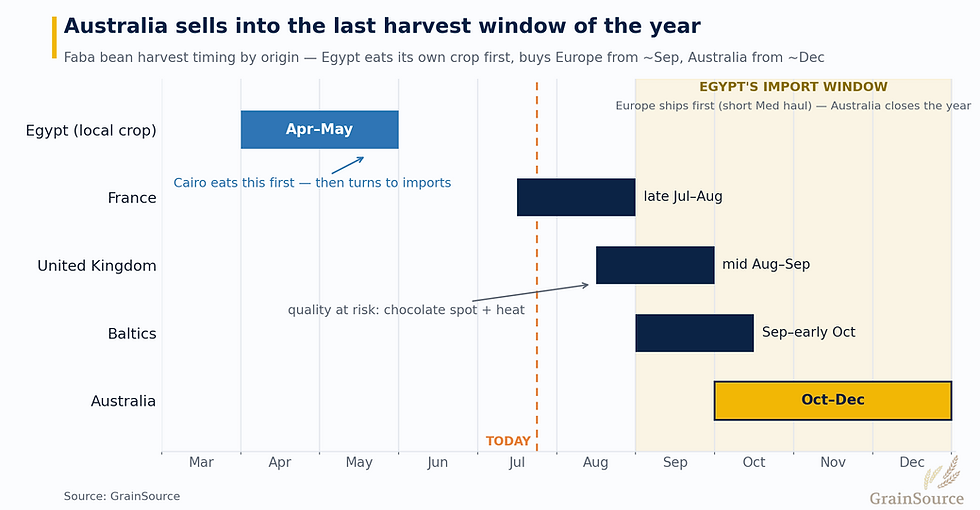
Persistent water-logging through winter triggered the PGRO's earliest-ever chocolate spot advisory in February. Spring crops have been moisture-stressed on lighter soils. Late-June heat across northern Europe has added further risk to both the UK and Baltic crops.
New-crop UK feed beans are indicated around £215/mt ex farm — roughly the low-$400's/mt in Australian dollar terms. The quality behind that number is unresolved until samples are cut.
Egypt's own harvest sets the clock. The local crop comes off in April and May, and Cairo works through that supply — plus any carryover — before importing in size. European new crop lands from roughly September; Australian new crop from December.
Every week of domestic supply Egypt still holds is a week it can afford to keep watching. The calendar, however, only runs one way.
That split matters more than any headline European tonnage. Egypt does not buy “Europe”; it buys specific parcels of cooking-quality beans.
As we outlined back in our November analysis, Egypt imports 500–550kmt of fabas in a strong buying year, and Australia normally supplies 50–70% of it.
The balance comes from the UK, France and the Baltics — the very origins now fighting water-logging, disease and heat.

A large French crop with sound quality caps early-window values. A UK and Baltic harvest compromised by disease and heat pushes Egyptian demand toward the one reliable origin left in the calendar: Australia.
The question is not whether Europe has beans. It is how many of them Egypt will actually want.
Australia Is Still Trading Production Risk
ABARES forecasts 2026/27 production at 875 kmt from 443,000 ha, against last season's record 1.02 million mt from a near-identical area.
The decline is yield-led, not area-led. Growers have not walked away from fabas; the forecast simply assumes yields return to trend after an exceptional year.
That distinction matters.
An area-led decline is locked in at planting. A yield-led forecast is still live, and will move with spring rainfall.
In our opinion, the market is not trading 875 kmt. It is trading a range either side of it, and it will keep doing so until spring.

The Stalemate at Port Is Rational
At $400/mt delivered port zones for 25/26 beans still held on-farm, growers see a bid that, in our view, reflects neither their higher cost base nor the production risk still in front of the new crop. This far from harvest, with no cash-flow pressure forcing sales, they are under no obligation to accept it.
Buyers see the other side of the same ledger. Egypt is showing minimal demand while European harvest results arrive, domestic feed demand is soft on ample southern feed conditions, and there is no execution pressure to own beans today.
Both positions are rational. That is exactly why volume is thin.
The market is not broken. It is waiting — and what it is waiting for is Europe.
Freight Is Priced In; Fuel Is the Live Variable
Getting Australian beans to Egypt means sailing around Africa — a routing the market has carried since the Houthis first closed the Red Sea, and one now reinforced by Iran's on-and-off closure of the Strait of Hormuz.
The penalty is real, but it is old news. Roughly 3,800 extra nautical miles and 10–14 days, embedded in the spread between Australian port values and landed Egypt long ago.
What is not old news is fuel.
Brent traded near US$72/bbl before the February escalation, spiked to US$118/bbl at the height of the March closure, and is back above US$100/bbl this week — up almost 14% in five trading days as the renewed US–Iran confrontation chokes the strait. Hormuz transits collapsed by around 90% year-on-year in the week to 19 July. Bunker prices are following fuel higher, and this week's surge is still washing through freight.
Freight costs have moved broadly in line with fuel. Every dollar on bunkers flows directly into what an exporter can pay at port.
Europe, meanwhile, ships to Egypt on a short Mediterranean haul that carries neither the Cape routing nor the war-risk insurance now quoted at up to 5% of hull value in the Gulf. That advantage belongs to Europe in the early window.
We believe Australia's answer has to be quality and timing, not freight.
Forward Bids Must Pay for Risk
There is no meaningful forward market for new-crop (26/27) fabas yet — the beans now in the ground for an October–December harvest. When forward bids do emerge, we believe they should be read carefully.
A forward price this far from harvest asks the grower to carry yield risk, quality risk and delivery obligation for another three to four months. That risk has value.
A forward bid at or below today's spot-equivalent levels is asking growers to give that value away, and we expect most will decline — exactly as they are declining $400/mt spot.
The forward market that eventually clears will need to carry a visible premium over current bids, or it will not attract tonnes.
A Five-Cent Currency Move Is Worth About $35/mt
Egypt buys in US dollars. Australian growers sell in Australian dollars. The exchange rate moves the domestic value of every export parcel without a single tonne trading.
On a value in the mid-$400's/mt, the arithmetic is roughly as follows:
AUD five cents stronger: export parity falls by around $30–35/mt. The buyer ceiling compresses toward current bids, and the stalemate hardens in buyers' favour.
AUD stable: currency is removed from the equation. Europe's harvest quality alone decides who blinks first.
AUD five cents weaker: export parity lifts by around $35–40/mt. Buyers can meet sellers at $440–450/mt without Egypt paying a dollar more in US terms — the cheapest way this stalemate resolves in growers' favour.
The currency can bridge, or widen, the entire $40–50 gap between bids and offers on its own. It deserves as much attention as the weather.

GrainSource View
Our base case is that the stalemate holds until European harvest quality is known through August and September.
If France delivers volume and quality, Egypt covers its early window cheaply and Australian bids stay defended at current levels for longer. If UK and Baltic quality disappoints — and the disease and heat evidence points that way — Egyptian demand arrives in our window earlier and with more urgency than current bids assume.
Either way, we do not expect meaningful grower selling at $400/mt delivered port zones while costs, production risk and time all sit on the growers' side of the table.
Upside remains if northern European quality fails or the Australian dollar weakens. Downside risks include a clean French export program landing on a stronger Australian dollar.
Europe will break the stalemate. Our base case is that patience — not the next bid — is what gets rewarded when it does.
Forecast
Price direction: supported. We expect the $400/mt delivered port zone bid to be tested higher before growers test lower, with the mid-$400's/mt offer levels the first resistance.
Grower selling: minimal until European quality is known; no cash-flow trigger visible this far from harvest.
Forward markets: any forward bid must carry a visible premium for production and quality risk to attract volume.
Key external determinants: UK and Baltic harvest quality (August–September) and AUD/USD, worth roughly $35/mt in either direction for every five cents.
Source notes: ABARES 2026/27 forecasts; PGRO advisories and UK trade indications (July 2026); European trade reporting (June 2026); oil, freight and shipping indications from market reporting as of 24 July 2026. Prices are indicative delivered port zone values in Australian dollars unless stated.
This report is general information only. It does not constitute financial, investment or marketing advice, and does not take into account the objectives or circumstances of any individual grower or buyer. Seek independent advice before making selling or purchasing decisions.


Comments