
Failure Beans in Europe? - Bullish for Australia
- Simon Hutt
- 3 days ago
- 7 min read

Updated: 22 hours ago
Three weeks ago we called this market a stalemate and said Europe would break it.
Buyers were bidding $400/mt delivered port zones for current-crop (25/26) beans. Sellers were asking $440-450/mt. Almost nothing traded.
Worth being clear on what that $400/mt actually is: a placeholder, not a bid with real depth behind it. It's where the market last looked, not a level anyone's moving genuine volume on. Treat every reference to it below the same way.
Our estimated selling price floor for 25/26 has held at $415/mt since last year's harvest. For the upcoming 26/27 crop, we're lifting that selling floor by $20 to $435/mt - driven largely by higher input costs.
The $400/mt placeholder bid is already sitting below even the 25/26 floor, let alone where next year's crop needs to clear.
What we were waiting for though is that Europe has moved - especially Lithuania.
Faster and further than our 24 July review assumed.
The UK Harvest Has Failed, Not Just Slipped
The UK is on track for its worst arable harvest since records began in 1984.
Heatwaves through May-June-July.
The driest July on record in England and Wales.
Early feed bean yields in southern England are running at 2mt/ha, against a normal range of 3.7-4.9mt/ha. AHDB had the crop 44% harvested as of 27 July.
England has now gone seven straight weeks under 10mm of rainfall.
August has brought just 6% of the long-term average.
Four more Environment Agency areas moved into drought status in the week to 13 August. The last real rain fell in mid-June.
New-crop feed beans are indicated at £218-230/mt ex-farm, up modestly on last year. But nobody has a read on the export-quality premium yet. Sample quality is unconfirmed.
Egyptian buyers are watching, not committing.
This sits on top of a decline that was already structural. UK shipments to Egypt fell to just 27.7kmt in 2025-26 - the lowest since 2020-21. This season's weather makes a bad trend worse.
The Baltic Is Wet Where the UK Is Dry
Lithuania's LRT reported persistent rain and unusually cool weather disrupting harvest through mid-July, on top of earlier heat that had already dried out flowering pods before they set.
The EU's JRC crop bulletin named north-eastern Poland, western Latvia and western Lithuania specifically for above-average rainfall risking delayed harvest, reduced quality and disease.
Same story as the UK. No firm new-crop export price.
Nobody committing until quality is confirmed.
What a Lithuanian Shortfall Actually Costs Egypt
At a 30-40% Lithuanian crop cut, that's 17-23kmt disappearing from Egypt's supply pool - before the UK loss is even added.

The number could move either way from here.
This assumes production cuts pass through proportionally to exports; if Lithuania protects domestic and EU demand first, as exporters typically do, the hit to Egypt-bound tonnage could be larger than shown, not smaller.
And we don't yet have a confirmed Lithuanian production-cut figure for this season - the reporting so far describes disrupted harvest and quality risk, not a specific yield number.
Treat this as the shape of the exposure, not a locked forecast.
Egypt's Options Just Narrowed
Egypt buys 495-550kmt of dried faba beans in a typical year - a figure that's held fairly steady, growing from around 407kmt in 2018 to 495kmt in 2023.
Four countries actually supply this market in bulk. On Egypt's own 2024 customs data: Australia 67%, Lithuania 14%, the UK 9%, Latvia 7%.

The three origins now fighting bad weather in the same window account for 30% of Egypt's supply.
France and the Black Sea get mentioned constantly in this market, but neither belongs on the supplier list. France's direct human-food channel to Egypt has reportedly been closed since before 2016 over unresolved weevil issues - current French volumes go mainly to Norway, for aquaculture.
Ukraine's entire vegetable export category to Egypt was worth just US$3.6M in 2024, against Egypt's $296M faba bean bill on its own, and none of Ukraine, Russia or Kazakhstan ranks among the world's top-10 producers. Beyond small opportunistic parcels, neither name moves this market.
These are Egypt's own reported splits, rebuilt on 2024 data. The exporting countries' own declarations put Australia higher again, at 74%. Either way, Australia is the dominant supplier by a wide margin.
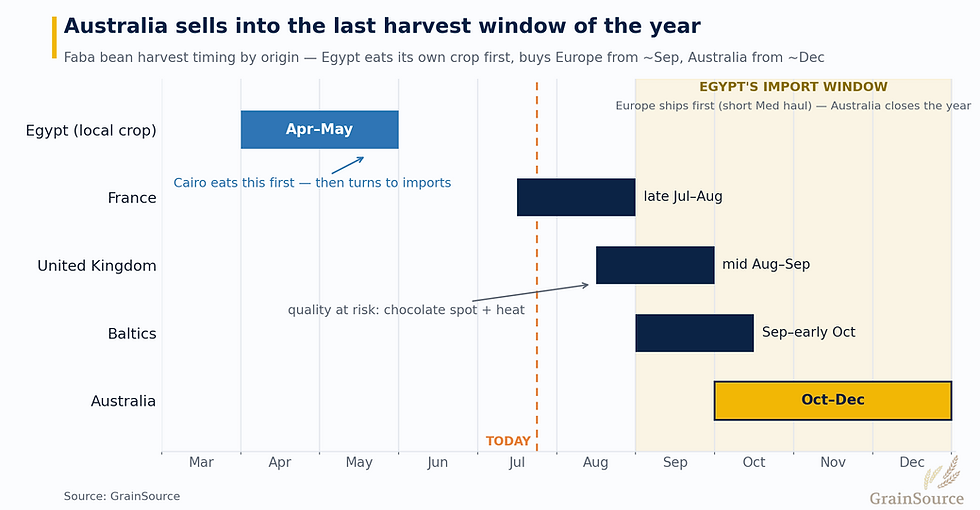
Egypt's own local harvest came off in April and May. Cairo is working through that supply, plus carryover, before it imports at size - its buyers can genuinely afford to keep watching for now.
We can't count Egypt's stock directly - nobody publishes that number. What we're reading instead is their buying behaviour: a genuinely short Egypt would be showing urgency right now, and it isn't. That's the best evidence we have, but it's a read on behaviour, not an actual count.
It has now moved from a live risk to something close to a confirmed fact pattern for the UK, with the Baltic pointing the same way.
Why This Doesn't Automatically Flow to Australia
Worth saying plainly: a Baltic and UK shortfall doesn't automatically become an Australian sale.
Egyptian buyers have flagged inconsistent cooking times in Australian parcels before, likely from varietal comingling. Baltic and UK beans are valued for cooking faster and using less fuel.
Egypt doesn't buy "Europe" - it buys specific cooking-quality parcels, and Australia has had trouble clearing that bar before.
Buyers get less picky when genuinely short of supply, as they did in 2022 - but they don't switch origins overnight, and they don't switch completely.
The North Is Struggling, the South Isn't
Our July review flagged ABARES's 875kmt forecast for 2026/27 - down from last season's record 1.02Mt on nearly identical plantings. That's a yield call, not a planting call, and yield isn't locked in until harvest.
Every signal since points down.
We would bet against 875kmt holding.
BOM confirmed a strong El Niño in June - now one of the strongest on record, still building into spring. Northern NSW and southern Queensland have been drier than average since January. Many growers didn't sow at all; those who dry-sowed caught a break that's now drying up again before grain fill.
That's not a rounding error. NSW alone grew around 430kmt of last season's 1.02Mt record - 42% of the national crop from one state - and Queensland added a further 28kmt, per ABARES. Combined, that's 45% of Australia's crop, on the ground now short of rain.
Victoria and South Australia are the other half, and the good half - same El Niño overhead, but growers there describe an excellent season.

ABARES updates this again in September - a full quarter of conditions, not a snapshot. The dry has only deepened since June; we'd be surprised if the number doesn't fall.
That matters beyond the total too. Australia's bulk program to Egypt opens out of Brisbane and Newcastle in November-December, carried by the north's early varieties, ahead of the bigger Victorian and South Australian harvest from January - the exact window Egypt reaches for first on a compromised European crop.
A lighter northern crop means a lighter, later start to it. And it's not just how much comes off - it's how much growers let go.
After a season this dry, expect them to hold new-crop tonnage back as their own drought insurance, selling only what cash flow demands.
That squeezes the window twice: less grown, less offered. That's upward pressure on price, not a neutral outcome.
The same instinct is already showing in old-crop selling too, with growers holding 25/26 stock while the new crop's fate hangs on spring rain.
Freight Is a Live Risk - Not a Resolved One
Brent crude has eased to the high-US$80s a barrel, down from the "above US$100" spike we flagged on 24 July. That looks like good news, but the war behind it hasn't ended.
The US reimposed its naval blockade of Iranian ports in early August after the June ceasefire fell apart, and talks are currently deadlocked. Prices have come down from the peak - they haven't come down because the risk is gone.
That risk hits Australia harder than it hits Europe.
Australian cargoes to Egypt sail the long way round Africa. European cargoes make a short trip across the Mediterranean with no war-risk insurance premium attached. If fuel and freight costs stay high, or spike again, Australian growers lose more of their delivered price to freight than European sellers do for the same trip.
AUD/USD, meanwhile, has barely moved - so if this changes what you'd expect to see, it's the freight risk doing it, not the exchange rate.
GrainSource View
We are not moving our destination - mid-$500's/mt delivered Southern Port Zones. Only our confidence in reaching it, and the timing, has changed.
Europe's failure is no longer a risk on the page - it's happening.
Forecast
Price direction: supported and firming. We expect the $400/mt delivered port zone bid to be tested higher, with mid-$400's/mt offers the first resistance and mid-$500's/mt delivered Southern Port Zones the destination.
Grower selling: minimal on both old-crop and new-crop expectations while the north's spring outcome and Egypt's buying timeline both remain open.
Key determinants: confirmed Baltic harvest quality through September, spring rainfall through grain fill in northern NSW and southern Queensland, the pace of Egyptian buyer commitment once its own local harvest position clears, and freight/fuel costs under an unresolved Strait of Hormuz conflict.
What We're Still Building
Our production-minus-exports surplus chart hasn't caught up to this season yet. The 2025-26 crop's record 1.02Mt sits against a CY2026 export figure that's still incomplete this deep into the year.
A genuinely reliable, tonnage-weighted breakdown of where Australia's own exports go beyond Egypt needs the ABS/DFAT customs data properly extracted - not the shipment-count trackers we've seen quoted elsewhere, which undercount bulk Egypt cargoes against the many small containerised parcels moving to South-East Asia.
We're building that properly and will bring the completed 25/26 surplus estimate and export-destination chart back in our next update
Data Note - 18 August 2026
Since publishing we rebuilt the Egypt origin-share figures in this report directly from UN Comtrade 2024 data. The original chart mixed 2023 and 2024 figures, which understated Australia's share of Egypt's import bill at 53%.
On Egypt's own 2024 customs return Australia is 67%; on the exporting countries' own declarations it is 74%. Lithuania is 14%, not 11%.
This strengthens rather than changes the call. A larger Australian share means Cairo has fewer places to turn with the Baltic and the UK both short.
Our price view is unchanged: mid-$500's/mt delivered Southern Port Zones.
Source notes: European Commission JRC MARS crop bulletin (27 Jul 2026); LRT (13 Jul 2026); AHDB/PGRO market updates and Hectare Trading price indications (Jul–Aug 2026); Defra/ECIU UK crop-condition data; AHDB/HMRC UK export data to Egypt; UN Comtrade/TrendEconomy Egypt import-origin data (2023); UN Comtrade Ukraine–Egypt bilateral trade data (2024); Tridge global dried broad bean production rankings (2023); European Commission EU legumes factsheet; ABARES 2026/27 forecasts (2 Jun 2026); Bureau of Meteorology seasonal outlooks; GrainSource grower and agronomist contacts, northern NSW and southern Qld (Aug 2026); trade commentary on Egyptian buyer cooking-quality preferences (Grain Central, 2020); Brent crude and AUD/USD market indications and Strait of Hormuz reporting as of 14–16 Aug 2026. Prices are indicative delivered port zone values in Australian dollars unless stated.
This report is general information only. It does not constitute financial, investment or marketing advice, and does not take into account the objectives or circumstances of any individual grower or buyer. Seek independent advice before making selling or purchasing decisions.
Comments